
Amid changes in the health care landscape, Rush University is galvanizing its community around what matters most — students, faculty and mission.
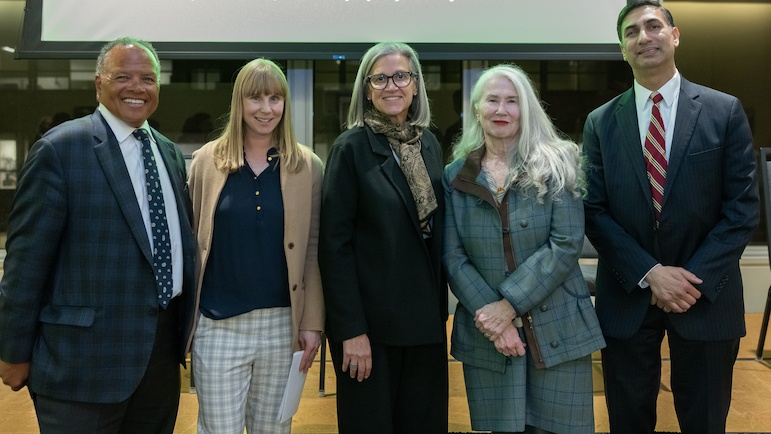
Rush University President Robert S.D. Higgins, MD, MSHA, recently moderated a panel featuring Rush University leaders who shared their strategic vision of the path forward for academic health care.
“My mom used to say: Pressure makes diamonds,” Higgins said. “We want to be a jewel in the crown of American health care. There are external and internal pressures, but I think we can handle them with our strong leadership team. We’re optimistic about the future.”
Panelists shared their insights into the future of Rush, with a focus on academic and clinical integration, paired with a collaborative spirit that guides the work of supporting students, advances the university’s mission, and strengthens community.
“We often can’t choose our external circumstances, but we can always choose how we respond to them,” Higgins said. “Leadership is critically important to guide those choices and to inspire our faculty, staff and students in the execution of our strategic plans.”
Toward a team science model
Pete Batra, MD, senior vice president and dean of Rush Medical College, identified Rush’s emphasis on clinical and academic integration as a key to the organization’s success.
“I really believe that integration is our secret sauce,” he said. “When we stay true to that, our clinical programs thrive, we can improve education, and our research is stronger.”
And as research increasingly moves to a team science model, Batra emphasized the need for openness to partnerships that can elevate the work. He sees philanthropy as critical to diversifying the funding streams — including governmental funding, industry-sponsored clinical trials and revenue — needed to sustain and grow innovative, team-based research programs.
The goal, he said, is to evolve the research mindset alongside digital transformation to meet the next generation’s technology-driven approach to the work. That means utilizing artificial intelligence and investing in big-picture innovation, with faculty and students working side by side to shape the future.
“I think our future’s bright,” Batra said. “We have a strong ecosystem of research here.”
Prioritizing students’ success and well-being
Nadine Lerret, PhD ’11, Rush University College of Health Sciences associate dean of academic and Al integration, said there is a cohesive feeling around Rush right now, with students and faculty addressing the moment together — including through research.
“It feels really exciting,” Lerret said. “Now, more than ever, scholarships are bringing students in who maybe didn’t have a chance before. They’re excited and bringing a whole new angle to how we’re pushing health care forward.”
Julie Hoff, PhD, RN, FAAN, provost of Rush University, addressed how students navigate the financial hurdles of higher education.
Right now, Rush University is adapting to financial cuts to higher education, including some of the most significant changes to federal student aid in decades. Grad PLUS Loans are slated to end, and borrowing limits for Direct Unsubsidized Loans will be significantly capped in July 2026. Most Rush students rely on these programs. Without them, many may need to turn to higher-interest private loans with fewer protections — making access to graduate health education more difficult at a time when the U.S. faces critical workforce shortages in the health care field.
“When we talk about the need students have, we also have to realize the world is far more complex than it used to be — so much faster-moving,” Hoff said. “We’re building financial aid and financial management coaching because the world will be changing.”
Rush remains committed to providing a high-quality education at the best value by minimizing tuition increases and offering robust financial support — which is now more important than ever.
Hoff also highlighted Rush’s commitment to supporting students’ mental health, which includes offering unlimited access to behavioral support via the student wellness center.
Navigating uncharted territory
Christine M. Kennedy, PhD, RN, FAAN, dean of the College of Nursing, emphasized the importance of supporting the next generation of health care leaders.
“We are driven by young learners,” she said. “The students and the junior faculty are the engine propelling us. They want to advance. They want to make improvements, and they want to make a difference.”
One of the ways the next generation can foster change, according to Lerret, is through digital transformation, with AI now a common theme across the 15-plus programs in the College of Health Sciences.
“It’s not a question of if health care professionals are going to interact with AI; it’s a question of how,” Lerret said. “I’ve been speaking to our educators about the goal for our students to utilize AI responsibly, with compassion and for the benefit of the patient. By coupling AI with Rush’s values, we can leverage the tools at our fingertips for the greater good of our patients.”
Kennedy added that, in a daunting funding landscape, Rush deans need to provide additional support to students and junior faculty navigating their career paths.
She highlighted how philanthropic partners help break down the barriers in a challenging environment.
“We are grateful to the donors who have stepped up and asked: ‘What will it take? What can we do?’ These are challenging times, but the community here really has helped with the soft landing,” Kennedy said.
With passionate students and alumni acting as the heartbeat of the institution, Rush’s leaders remain positive about the future.
“There are large promises to deliver on, in terms of our mission and strategic plan, but we have excellent staff and faculty,” Kennedy said. “Together, with the support of our philanthropic and community partners, we can enter an uncharted future and face challenges head-on.”