

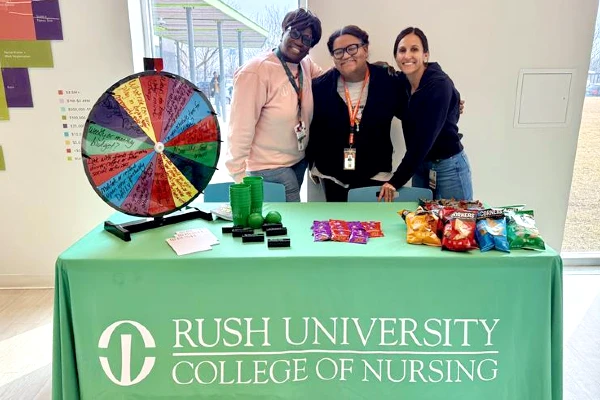
How partnering works:
Faculty RNs and/or APRNs will come to you to establish onsite clinical care.
We partner with:
- Businesses
- Social service organizations
- Philanthropists
- Government agencies
- Health care providers
Our services include:
- Direct nursing care
- Primary care for men, women and children
- Mental health services
- Health and wellness education
- Health care consultation and referrals
- In-depth community-based research
- Public health and quality improvement
If you're interested in partnering with Rush Nursing Faculty Practice to establish a clinical site or receive health care consultation, contact Annika Gorenz, our senior manager, at Annika_Gorenz@rush.edu.
-
What types of organizations do you partner with?
We partner with employers, community-based organizations, and healthcare or clinical entities seeking to improve access to care, advance population health goals, support workforce wellbeing, or collaborate on care delivery and training models. Our partnerships are designed to be flexible and tailored to the needs of each organization.
-
What services or activities can a partnership include?
Partnerships may include on-site or near-site clinical services, telehealth-enabled care, health promotion and wellness programming, community outreach, and/or education and training activities. The scope of services is defined collaboratively based on organizational goals, population needs, and operational feasibility.
-
How are partnerships structured and formalized?
Partnerships are typically formalized through an agreement that outlines roles, responsibilities, scope of work, and governance.
-
How are clinical, regulatory, and credentialing requirements handled?
Clinical and regulatory requirements—such as licensure, credentialing, and privileging—are addressed during partnership planning and vary based on the care model and setting. Telehealth and multi-site care are delivered in accordance with applicable state and organizational requirements.
-
How is the partnership funded?
Funding structures vary and may include service agreements with invoicing, grant or philanthropic support, or hybrid models, depending on the partnership scope and partner type. Financial expectations and processes are clearly defined in the agreement.
-
Can partnerships scale or expand over time?
Yes. Many partnerships are designed to grow or evolve, including expansion to additional sites, populations, or services. Scaling considerations such as staffing, licensure, and operational readiness are addressed collaboratively.
-
What outcomes or benefits can partners expect?
While outcomes vary by partnership, prior models have demonstrated benefits such as improved health outcomes, high patient satisfaction, and organizational value through accessible and cost-effective care models. Evaluation and quality improvement activities are incorporated into partnership design.