
Program Objectives
The RMC Program Objectives are organized around six roles that a physician plays and the foundational role of medical knowledge that supports them:
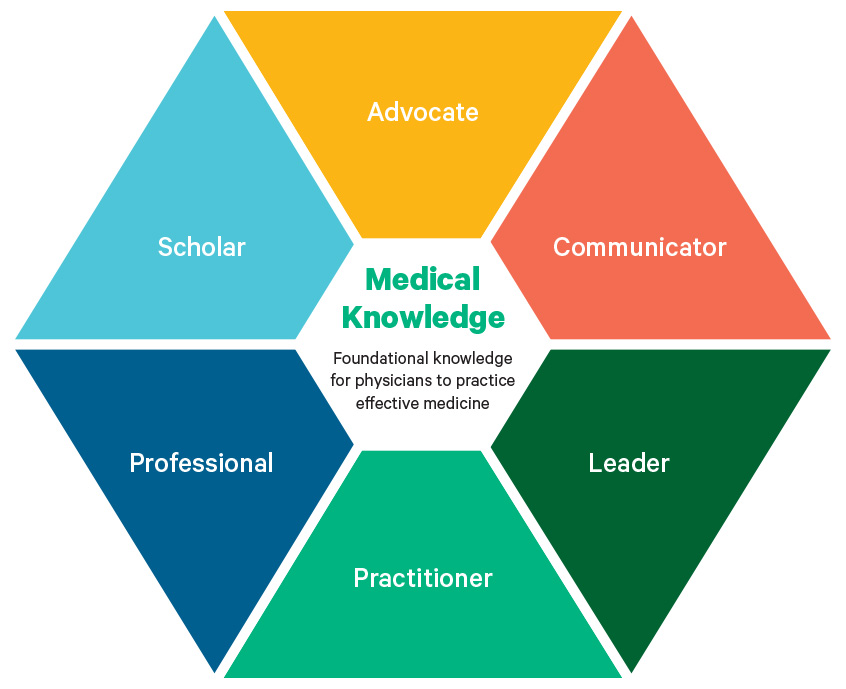
Advocate: Identify and address social, political and cultural factors that affect the health of patients and populations to improve health equity.
Communicator: Establish strong therapeutic relationships with patients and their families to cooperatively provide care that reflects their needs, values and preferences.
Leader: Contribute to the improvement of health care quality by participating in a culture of safety and coordinating care between the various elements of the health care system.
Practitioner: Collect, interpret and document information to make clinical decisions and carry out diagnostic and therapeutic interventions to provide high-quality patient care.
Professional: Demonstrate a commitment to carrying out professional responsibilities and upholding the legal and ethical principles that support medical practice.
Scholar: Use evidence-based principles to continually enhance one’s own practice, inform care of your patients and develop the skills to contribute to the scientific knowledge of the field.
Medical Knowledge: Demonstrate knowledge of established and evolving biomedical, clinical and social-behavioral sciences, and the application of this knowledge to patient care.
Shaping the Curriculum
You can participate on curriculum committees to help guide how the curriculum is designed, implemented and evaluated. You will work with faculty to have a direct impact on medical education at Rush.
Committees include the following:
- Committee on Curriculum and Evaluation: The overarching curriculum committee for Rush Medical College. Members include faculty, administrators and students.
- Student Curriculum Advisory Committee: An independently run, student-only committee that is the main student voice for influencing the curriculum.
- There are also so many other committees to serve on that help to shape Rush Medical College!
Graduation Requirements
This four-year program includes core courses, electives, core clerkships and clinical sub internships. Candidates for the MD degree must complete all of the required course work, pass USMLE Step 1 and USMLE Step 2 and receive approval from the promotions committee (COSEP) in order to graduate.
Course Curriculum
Preclerkship Phase
First-year required courses
- RMD - 560 The Foundation of Medical Practice (Credits: 2)
- RMD - 561 Host Defense and Response (Credits: 6)
- RMD - 574 Vital Fluids (Credits: 9)
- RMD - 575 Vital Gases (Credits: 5)
- RMD - 563 Food to Fuel (Credits: 6)
- RMD - 564 Movement and Mechanics (Credits: 6)
- RMD - 565A Brain, Behavior and Cognition A (Credits: 4)
- RMD - 565B Brain, Behavior and Cognition B (Credits: 4)
- IPE - 502 Interprofessional Person Centered Teams (Credits: 0)
- IPE-502 is taken twice over fall and spring terms
Subtotal: 42 Credits
Professional Development Course
Choose one course below for 2 credits.
- RMD - 590A Professional Development: Academic Enrichment (Credits: 2-4)
- RMD - 590B Professional Development: Clinical Experience (Credits: 2-4)
- RMD - 590C Professional Development: Community Service (Credits: 2-4)
- RMD - 590D Professional Development: Research (Credits: 2-4)
Subtotal: 2 Credits
Optional first-year electives
Elective courses may be taken in parallel with the required first-year curriculum. These courses do not count as elective weeks required for graduation.
- RMD - 538A/B/C Basic Spanish for Medical Professionals I, II, III (Credits: 1)
- RMD - 539A/B/C Intermediate Spanish for Medical Professionals I,II,III (Credits: 1)
- RMD - 540A/B/C Humanities in Medicine I,II,III (Credits: 1)
- RMC - 500 Basic Biomedical Research (Credits: 1)
- Taken in M1 Summer term by those students who receive a Summer Research Fellowship.
Second-year required courses
- RMD - 566 Sexuality and Reproduction (Credits: 5)
- RMD - 567 Health Across the Life Span (Credits: 5)
- RMD - 568 Introduction to Hematology and Oncology (Credits: 8)
- RMD - 569 Complex Cases and Transition to Clerkship (Credits: 12)
Subtotal: 30 Credits
Professional development courses
Students will select three professional development courses during their second year for a varying number of credits at specific points in the curriculum.
- RMD - 590A Professional Development: Academic Enrichment (Credits: 2-4)
- RMD - 590B Professional Development: Clinical Experience (Credits: 2-4)
- RMD - 590C Professional Development: Community Service (Credits: 2-4)
- RMD - 590D Professional Development: Research (Credits: 2-4)
Subtotal: 10 Credits
Clerkship Phase
Third year
The third year begins with the orientation called Clinical Resources and Skills for the Hospital (CRASH) followed by a year-long course series (RMD 749) and 42 clinical weeks in the required core clerkships: internal medicine, neurology, obstetrics & gynecology, pediatrics, psychiatry, primary care, and surgery. If eligible, the student may be able to take six weeks of elective courses during the third year. These electives do not count as elective weeks required for graduation.
Note: Students must take the USMLE Step 1 as a pre-requisite for enrollment in the core clerkships. Students must pass USMLE Step 1 as a graduation requirement.
- RMD - 749 Rush Integrated Clinical Experiences (Credits: 1)
- Taken three times
- MED - 703 Core Clerkship: Internal Medicine (Credits: 8)
- NEU - 701 Core Clerkship: Neurology (Credits: 4)
- OBG - 703 Core Clerkship: Obstetrics-Gynecology (Credits: 6)
- PED - 701 Core Clerkship: Pediatrics (Credits: 8)
- PSY - 701 Core Clerkship: Psychiatry (Credits: 4)
- RMD - 701 Core Clerkship: Primary Care (Credits: 4)
- SUR - 701 Core Clerkship: Surgery (Credits: 8)
Subtotal: 45 Credits
Fourth year
The fourth year involves a year-long course series (RMD 750), a required 4-week emergency medicine clerkship, a required 4-week senior sub-internship, a 4-week clinical bridge course (RMD 722), and a series of elective clerkships which ultimately comprise a minimum of 48 total weeks.
Note on Electives: Students are required to complete a minimum of 24 weeks of elective clerkships. Only electives taken during the student’s fourth year fulfill this requirement; electives taken in other years do not fulfill this requirement. The choice of electives is guided by student interest and the goal of creating an educationally balanced undergraduate experience. A maximum of 16 weeks of elective clerkships may be taken in a single subspecialty. Up to 12 weeks of elective clerkship may take place at another institution accredited by the Liaison Committee on Medical Education (LCME) or the Accreditation Council for Graduate Medical Education (ACGME).
All students must take and pass the USMLE Step 2 Clinical Knowledge (CK) as a graduation requirement.
- RMD - 750 Transition to Residency (Credits: 4)
- Taken three times
- EMD - 703 Core Clerkship: Emergency Medicine (Credits: 4)
- RMD - 722 Clinical Bridge (Credits: 4)
Choose one of the following subinternship courses:
- FAM - 710 Subinternship: Family Medicine (Credits: 4)
- MED - 710 Subinternship: Internal Medicine (Credits: 4)
- OBG - 711 Subinternship: Obstetrics and Gynecology (Credits: 4)
- PED - 710 Subinternship: Pediatrics (Credits: 4)
- SUR - 710 Subinternship: General Surgery (Credits: 4)
Subtotal: 48 Credits
Specialty Curriculum Programs
We offer two four-year longitudinal programs: family medicine and health equity and social justice. Learn more about the course requirements for these programs in the course catalog.
View the current course catalog
Refer to the course catalog for our most up-to-date curriculum information.