
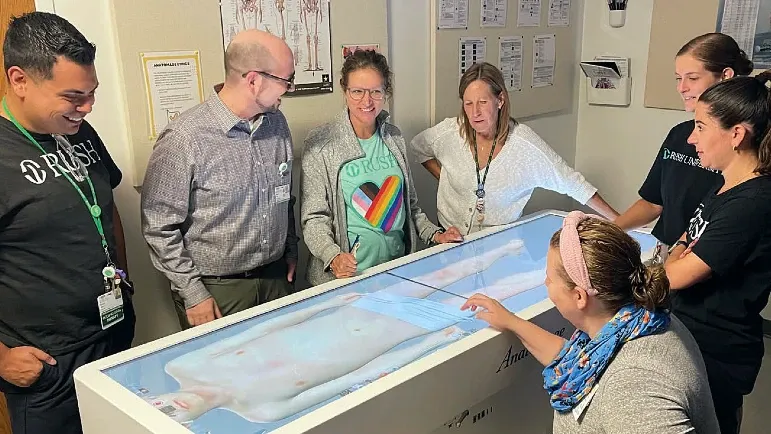
As a second-year occupational therapy doctorate (OTD) student and anatomy tutor, Lauren Simons knows how challenging it can be for first-year students to learn the structure of the human body. To help students gain more confidence with this foundational subject, Simons turns to cutting-edge technology tools called Anatomage tables. These highly advanced anatomy visualization and virtual dissection tools allow students to see inside digital bodies.
“Anatomage tables are a great tool to help supplement the content that first-year OTD students learn from anatomy lectures, discussions and cadaver lab sessions,” says Simons, who is originally from Somers, N.Y. She often uses the two tables at Rush to create quizzes in her tutoring sessions and prepare students for their exams.
Providing another opportunity for interactive learning
“In the OTD program, we focus mostly on muscles and nerves located throughout the body,” says Nora Harvel, a second-year OTD student and anatomy tutor for first-year OTD students. “Using the Anatomage tables, we can isolate specific muscles and nerves and make them easily visible and identifiable to the students.”
Harvel, who is from Crystal Lake, Ill., was drawn to Rush’s OTD program for the individualized learning experience it provides students. “I chose the OTD program at Rush because I knew that I would get a great clinical experience and the class size was small, allowing for a more individualized learning experience,” she says. “We get hands-on experience during our first semester and continue to be exposed to occupational therapy throughout the rest of the program. Overall, the program prepares students to be amazing, entry-level OTs.”
“We’re striving for excellence and innovation in everything we do, and without technology, we wouldn’t have the opportunity to be leaders who are advancing the profession of occupational therapy.”
Simons agrees, adding that the early hands-on experience allows students to build their knowledge and become proficient and well-rounded clinical OTs. When selecting her OTD program, Simons was drawn to Rush by the faculty. “I chose Rush OTD because of how passionate and kind all the faculty are and how willing they are to help me as a student in my journey of learning to be an OT,” Simons says.
Leading OTD education by embracing technology
Rush’s two Anatomage tables are just one example of how the OTD program is utilizing technology to prepare the next generation of occupational therapists. OTD students can also experiment with Moxie robots, which use artificial intelligence to engage children in meaningful play while supporting child development. In addition, aspiring OTs at RUSH can learn to use 3D printing to create customized prosthetics, splints and other devices for patients.
Embracing technology to prepare future OT leaders has helped Rush’s OTD program earn a ranking among the nation’s top 20 programs by U.S. News & World Report.
“We’re striving for excellence and innovation in everything we do, and without technology, we wouldn’t have the opportunity to be leaders who are advancing the profession of occupational therapy,” says Becky Ozelie, DHS, OTR/L, FAOTA, chairperson of the Department of Occupational Therapy and OTD program director.