
Introduction
Still Accepting Applications for
September 2026
New Flexible Part-Time Option for the MS in Biotechnology Program
We are excited to announce a new flexible pathway for students pursuing the Master of Science in Biotechnology degree. Students now have the option to complete the program on a part-time basis over a 5 semster period, providing greater flexibility while still earning a graduate degree in a timeframe comparable to many traditional full-time master's programs.
This part-time option is ideal for students who are preparing for the next step in their academic or professional journey. Whether your goal is to strengthen your application for medical, dental, pharmacy, or other professional programs, become a more competitive candidate for PhD programs, or enter the biotechnology industry with an advanced degree, the part-time pathway allows you to pursue these goals while maintaining your current professional and personal commitments.
Benefits of the Part-Time MS in Biotechnology Option:
- Continue working while earning your master's degree
- Gain advanced scientific knowledge and biotechnology training that can strengthen applications to professional and doctoral programs
- Build valuable experience and professional connections while completing your degree
- Maintain income and employer-sponsored benefits during your studies
- Balance academic goals with work, family, and personal responsibilities
- Reduce your course load each term for greater flexibility and work-life balance
- Apply newly acquired skills and knowledge to real-world professional experiences
- Complete your degree in approximately 5 semsters—similar to the length of many full-time master's programs at other institutions
The part-time MS in Biotechnology option provides a flexible and accessible pathway for students seeking to enhance their academic credentials, prepare for advanced study, or position themselves for success in the rapidly growing biotechnology industry.
Prefer an accelerated experience? We continue to offer our traditional full-time MS in Biotechnology program, which can be completed in just 9 months, allowing students to quickly gain advanced training and move forward with their academic and career goals.
Program highlights:
- Flexible enrollment: Full-time or part-time starting Fall 2026
- Timeline options:
- Full-time: Complete in as little as 9 months (accelerated 2 semesters)
- Part-time: Complete over two years (5 semesters)
- Strengthens graduate/professional school applications
- Research training with active faculty investigators
- Academic medical center in Chicago's Medical District
Rolling admissions:
The program offers rolling admissions and all applicants are reviewed as materials are submitted, and seats may fill before the final deadline.
Student-Focused & Encouraging: Applying to our MS in Biotechnology program means you're already in the running for a scholarship. Every completed application is automatically reviewed for financial awards at the time of admission — so submit your application and let us take it from there. Recipients will be notified in their official offer of admission email.
Take the next step
If you’re looking to become a more competitive applicant or launch a science-driven career, now is the time to apply.
Build your credentials. Strengthen your application. Advance your future.
Apply now for September 2026.


Our approach
You obtain hands-on experience at one of the nation's top academic medical centers, Rush University Medical Center.
You'll learn from faculty who practice in their field and are accomplished researchers.
You’ll gain certification in Good Laboratory Practices (GLP), which involves setting up, maintaining and working in a laboratory under federal regulations.
The biotechnology curriculum covers guidelines for the humane care and use of animals in research.
You'll work with live research animals, per Institutional Animal Care and Use Committee protocols, under the guidance of a laboratory animal veterinarian.
Rush is excited to introduce a new search engine for students in the Division of Translational Science, featuring a list of over 500 faculty members who are accepting students in our DTS programs. This searchable platform allows students to explore opportunities by keyword and department, offering a centralized resource to see who is accepting students and in which program, and access links to faculty profiles and publications. Students can also send a direct email through the platform, which will notify the student research coordinator to facilitate connections.
Program length and location for the MS in Biotechnology
The MS in Biotech Program is a two-semester, non-thesis program designed for students who may not want to commit to a traditional two-year master’s program.
Coursework and laboratory training take place on campus. A minimum of 34 credits is required for graduation.
Program tuition for the MS in Biotechnology
We know your education is a big investment. We want to make sure you have all the information you need to make the best financial decisions for you and your family.
Tuition for the Master of Science in Biotechnology program is $22,908 per term.
There are a limited number of scholarships for the program, including academic and diversity-based scholarships.
Learn about some of our recent students, their experiences and why they chose Rush University.
Biotechnology career opportunities
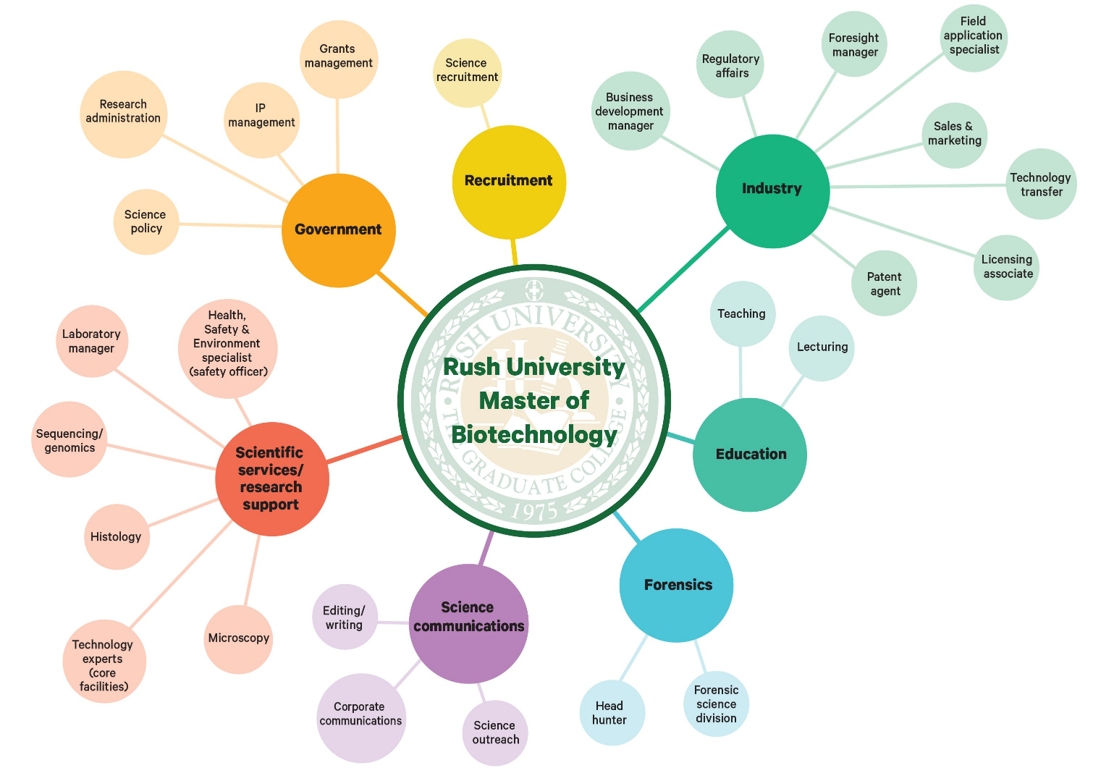
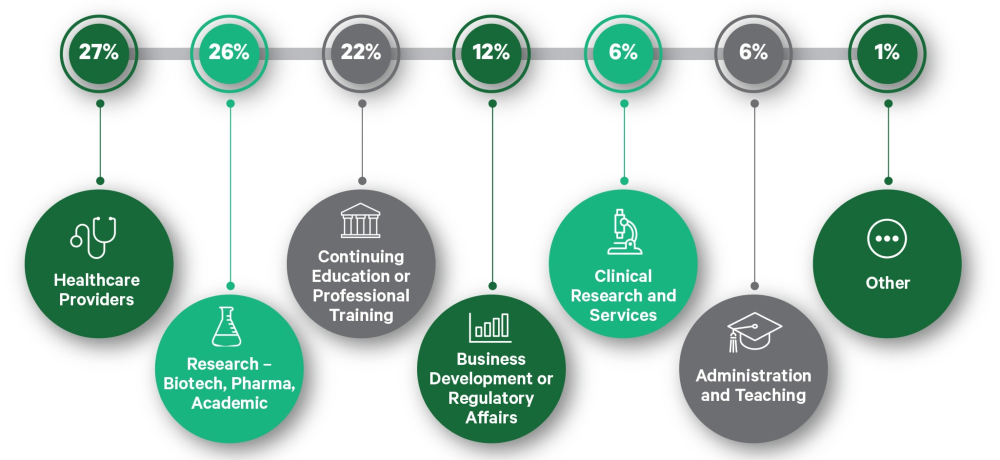
There are a variety of career paths for those who earn an MS in Biotechnology degree. Following are some facts about the paths our graduates pursue:
- Ninety-five percent of our graduates work at university laboratories and biotechnology or pharmaceutical organizations. Or they pursue advanced degrees in science (PhD) or medicine (MD, DDS, DO, or PharmD).
- About 60% of our graduates go on to medical or dental school.
- About 20% of our graduates go on to a PhD program.
- Graduates can become laboratory instructors or managers. They may also pursue further education to become high school or college science teachers.
The following are some of the more popular types of biotechnology careers:
- Agricultural engineer
- Biochemist
- Biomedical engineer
- Biotechnology laboratory technician
- Environmental engineer
Salaries vary depending on various factors, including role and location. The median salary for biological lab technicians was $52,000 in 2024, according to the U.S. Bureau of Labor Statistics. Biomedical engineers have a median salary of $106,950, while environmental engineers' median salary is $104,170.
 Rush Medical College
 Rush Medical College
 Rush Medical College
 Rush Medical College
 Rush Medical College
 Rush Medical College
 Rush Medical College
(312) 942-3589
dts_admissions@rush.edu
Sign up to receive more information about this program.