
Just after midnight on May 26, a person with a gunshot wound to the lower left leg arrived at Rush Oak Park Hospital’s Emergency Department. While Rush Oak Park is not a designated trauma center, members of the emergency team sprang into action using a Stop the Bleed (STB) kit to stabilize the patient before he was safely transferred to Loyola University Medical Center.
For the team involved, the moment reinforced the importance of preparation, collaboration and training.
“This is exactly why the STB kits were implemented,” said Gabbi Henderson, safety officer at Rush Oak Park. “To have staff respond so confidently and effectively in a real emergency is incredible. These tools and the education behind them make a difference.”
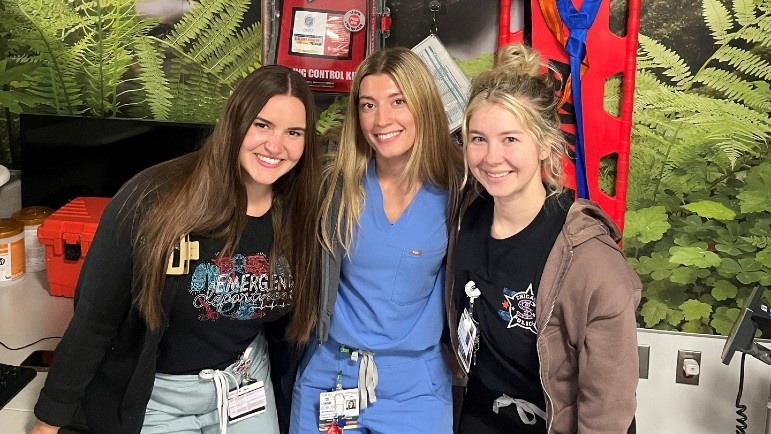
The response involved a coordinated effort from emergency physician Andrew Sexton, MD; registered nurses Jenna Keating, Meaghan Dorsey and Sarah Limjoco; and patient care technicians Alexandra Pavalon and Megan Lamonto, both of whom have become champions and instructors for STB kit training at Rush Oak Park.
From Student Vision to Systemwide Impact
The STB kit initiative began several years ago at Rush University College of Nursing as a capstone project developed by graduate entry master’s students who also worked as paramedics. Since then, the project continues to expand across Rush. Each kit contains trauma supplies designed to control severe bleeding with tourniquets, wound-packing gauze, pressure dressings and chest seals.
Yasmin Cavenagh, DNP, MPH, RN, CNE, associate professor in the Rush University College of Nursing and longtime faculty advisor for the project, said the initiative demonstrates the far-reaching impact nurses can have on patient outcomes.
“What started as a student idea has grown into something that is truly saving lives,” Cavenagh said. “Our students recognized that immediate bleeding control can mean the difference between life and death, and they were determined to bring that knowledge into hospitals and communities.”
More than six nursing capstone projects have since built upon the work, expanding training to emergency department staff, community organizations and partnerships with the Chicago Office of Emergency Management and Communications (OEMC) through the city’s Safe Chicago initiative.
Emma Dziura, RN, one of the original nursing students who helped launch STB training at Rush, has seen firsthand the impact of the initiative. Dziura presented the project internationally at the International Council of Nurses conference in Finland and later at the American Public Health Association conference in Washington, D.C., helping raise awareness about the importance of bleeding-control education.
After joining Rush Oak Park’s Emergency Department as a new graduate nurse, Dziura worked with academic advisors, nursing educators and community partners to continue expanding the program. Collaborating with Cavenagh and the OEMC, she helped bring STB kits to the hospital and support their installation throughout the campus.
The importance of that work became even more apparent during a patient emergency when Dziura used a tourniquet from the kit to control a severe arterial bleed after a glass table shattered and caused a significant injury. The experience reinforced the value of the training and equipment and strengthened her commitment to expanding the program.
"One of the biggest lessons I learned was that it's not enough to simply have the kits available," Dziura said. "Staff need to know where they are and feel confident using the equipment under pressure."
Building a Safer Environment
Today, STB kits are located throughout Rush, including at the medical center, the university and Rush Oak Park. The program is being expanded into Rush outpatient clinics and other locations. Rush Copley Medical Center is partnering with Oswego Emergency Management Services to lead a Stop the Bleed program in their community.
For Liz Williams MSN, RN, CNL, NEA-BC, unit director of the Rush Oak Park Emergency Department, the use of the kits underscores the value of readiness and teamwork across the system.
“This is a powerful example of what happens when education, innovation and collaboration come together,” Williams said. “Everyone involved — from students and educators to clinicians and operational leaders — play a role in helping save a life.”