
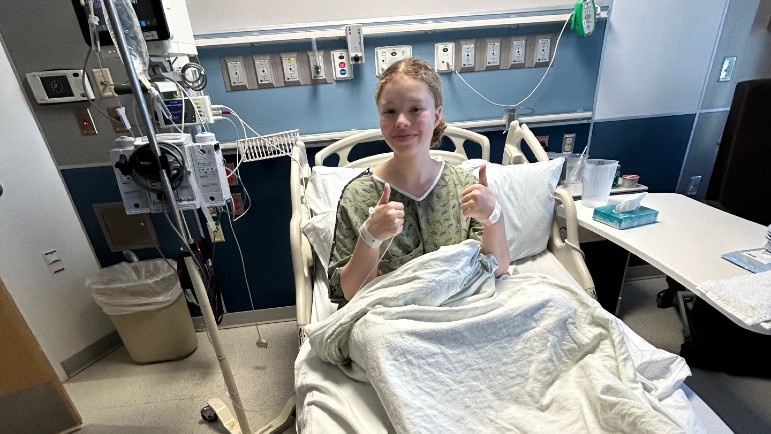
Madison Moore, a Speech Language Pathology student at Rush University, couldn’t think of a better way to spend the first few days of spring break 2025. She had a shopping day and ate dinner at her favorite restaurant with her family in the Chicago suburbs. It was the perfect day — until it wasn’t.
Moore was relaxing on the couch when she started to feel chest pain. She thought maybe she pulled a muscle at the gym, so she tried stretching and taking a hot shower to loosen whatever was aching. Quickly, she noticed something was seriously wrong.
“About two minutes in the shower, I could not stand,” she says. “I wrapped myself in a towel, crawled to my room and got in bed. That’s where the pain really started to deepen and get sharper.”
She doesn’t remember much besides being in the back of an ambulance on the way to Rush Copley Medical Center. Her pain was severe, and she couldn’t move her hands. Once doctors controlled her pain and did a scan, they redirected her care to Rush University Medical Center.
Back to school, but not for studies
“I was lying there in the ambulance thinking, ‘Am I dying?’” she says. “Based on my CT results, doctors said I needed to get to a level one trauma care center as soon as possible. They sent me in another ambulance downtown, which is where I go to school.”
Doctors at the medical center ran more scans and did many blood tests. They found that Moore’s liver enzymes were four times the amount they should be. Moore was diagnosed with Hepatocellular Adenoma — a rare, benign tumor form of liver disease.
Moore’s tumor was 17 centimeters, which is about the size of a melon. It was classified as a critical, life-threatening giant tumor because it had hemorrhaged.
“I’m super fortunate that it was caught as soon as it hemorrhaged and that I was taken care of so quickly because there was a very good chance that I wouldn’t have been so lucky,” she says.
Classes at the university were starting again, and while Moore was technically on campus, she was there for an entirely different reason.
“There were definitely a lot of moments where I wasn’t sure if I’d be able to continue school,” she says. “But we have incredible faculty and staff here at Rush. They’re just beyond amazing. They were flexible and let me take one of my classes online from the hospital because our program does have a summer semester,” she says.
Accessibility support on campus
Moore worked with the Office of Student Accessibility Services. She was given a clinical placement where she was able to sit down throughout the day instead of going from room to room across the hospital.
“I was left with all kinds of long-term conditions and referred pain. While I was hospitalized, I was diagnosed with dysautonomia and syncope, so I was fainting all the time,” she says. “The Office of Student Accessibility Services was paramount because they were able to give me different accommodations if I was having a bad health day, like taking rest breaks or requesting exams and quizzes to be taken online.”
OSAS supports students living with permanent and temporary disabilities that create access-related barriers to one or more parts of an educational experience. The office collaborates with faculty and staff when determining accommodation requests in all learning environments, including the classroom, laboratory settings and clinical sites. Each student engages in the interactive process to review their request with OSAS. When an accommodation is approved and implemented, the goal is to remove the access-related barrier to ensure the student has equal access to their curriculum.
When the office opened in 2016, there were 37 active cases of students needing accommodations. At the end of the most recent academic year, there were 417 active cases. That is a 900% growth rate in 10 years.
“Students should not feel ashamed to ask for support,” says Marie S Ferro Lusk, director, Office of Student Accessibility Services. “We are training future clinicians and health advocates. If they cannot advocate for themselves, how will they advocate for their patients?”
Strength through community
Moore experienced support from across campus. Classmates visited her in the hospital, brought her gift baskets, and even planned a fundraiser to help pay her medical bills.
“The fundraiser was through Rush University’s chapter of the National Student Speech Language Hearing Association. It was huge of them to think, ‘What can we do to make Madi’s ’s life easier?’” she says. “Two students even came to my house once I got discharged from the hospital, and they brought me blankets and made an Amazon storefront for me. It was above and beyond what I could have ever imagined.”
Moore will now graduate from the SLP program in December 2026. Though it’s hard to watch her friends move on before her, she is grateful for the opportunity to continue her academics and for support from the Rush community and family.
“My mom never left my bedside. My grandparents came to visit me, and my sister who lived out of state at the time came,” she says. “Also, the amazing doctors, nurses, surgeons, residents, and physical and occupational therapists. I am so grateful to everyone who saved my life and helped me recover.”
Learn more about student support services here.