
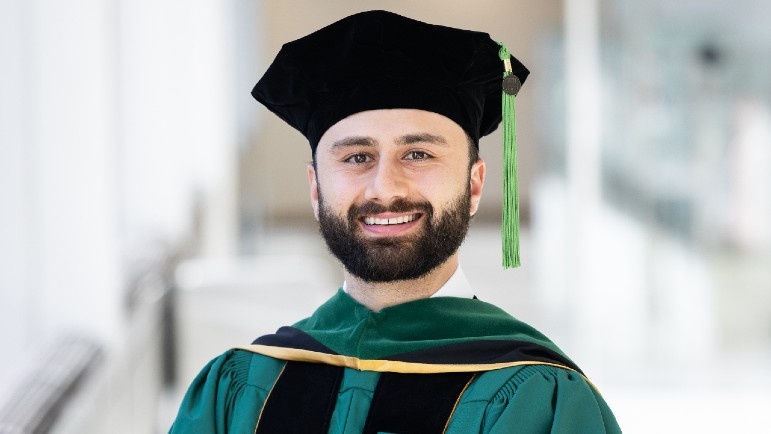
Avid cyclist and fourth-year medical student Andrew Mohama will serve as student speaker for Rush University’s 54th Commencement Ceremony.
Culture and community have always been important to Mohama. It was those values that not only led him to pursue a career in medicine, but to move to Chicago and attend Rush University. Mohama is passionate about listening to people's stories and being directly at the bedside.
During his time at Rush University, Mohama gained invaluable leadership experience. Currently, he serves as a physical exam teaching assistant where he guides students through real-time clinical encounters to build early patient-care skills. He founded Northstar Narratives, a storytelling organization that establishes platforms for medical learners, workers and patients to share stories with one another.
His love for cycling also inspired his research – where he biked from San Fransico to Chicago aiming to understand the implications of loneliness, social connection and community across the country.
Mohama will soon head back to San Francisco, but this time, to begin his career in medicine. In March, he matched in internal medicine at University of California, San Francisco.
Q&A with Andrew Mohama
What made you pursue a career in medicine at Rush University?
I was lucky to get into multiple medical schools, and I was faced with a very challenging decision because they were all in places that had something different and unique to my passions and interests. But I think what ultimately guided me to Rush was trusting that if I chose the institution that was the most mission driven and aligned with my foundational values, I would be making a good decision. Even though it’s really hard to see what an experience will be before you jump into it, I just relied on my past experiences where I made an uncomfortable decision to move somewhere new or do a big adventure that is grounded in service, community, kinship and social justice. Rush has absolutely fulfilled my interest.
You biked across the country for your research. Can you tell us more about that experience?
I developed a love for biking early in life. After my sophomore year of college, I biked from Maryland to San Francisco over the course of the summer. I did this with a group that was raising funds and support for young adults with cancer. It was a life-changing experience. It wasn’t the biking, mountains and beautiful views that I remembered the most, it was the people I met along the way and the conversations we had.
During my first year of medical school, I had a hard time. It was tough to study at my desk all the time, and I wasn’t interacting with people. I wasn’t in the hospital working with patients, so I wanted to make sure I did something that brought me in front of people. I also wanted another big adventure, and this time, I wanted to do it alone. I did another cross-country bike ride and asked people along the way about a topic I care about to turn it into an academic pursuit. I was interested in the topic of loneliness, community connection and how it affects various communities throughout the United States. I took the Amtrak to San Francisco with my bike and made my way back to Chicago. I interviewed about 100 people over the course of 30 days.
Do you have a favorite memory at Rush University?
This is a hard question because I have so many good memories. One moment that stands out to me is arriving back to Rush after my bike tour. I remember that day very vividly. I’ve made the bike ride to Rush hundreds of times because I commute to the hospital by bike most of the time, and to feel like I just finished this extended commute from the West Coast back home to Chicago and all my closest friends and mentors were there to welcome me right outside Armour Academic Center. It was an amazing experience, and I felt the love of my community.
What organizations were you part of during your time at Rush University?
I’ve been a peer advisor since my second year of medical school. Another thing I’ve been part of is called Northstar Narratives. It’s an organization I helped start during my first year with one of my classmates. It’s centered around storytelling.
Right now, I’m in the Schweitzer Fellowship which is a year-long service fellowship where you develop projects that help underserved communities. I partnered with a group called Working Bikes, which takes old bikes and gives them new homes. I’ve helped them with their Cycle of Power program that identifies people who can’t afford a bike or don’t have access to transportation, and we set them up with a free bike, helmet, lock and lights.
How has Rush inspired you as a health care provider?
Rush was not the place I came to, but it’s the place I’m going from. I’m going from Rush to move toward communities underserved, to move toward people who need help and people who are often not considered in the same level of humanity. I feel a deep sense of pride graduating from Rush because of how we care about social justice, health equity and the community. Rush has trained me to not lose sight of the humanity in people in front of you and to maintain empathy for diverse experiences.
Do you have advice for incoming medical students?
There’s one thing that’s very logical that I tell a lot of students. I always tell them before they embark on something challenging, like the first year of medical school or clinical rotations, sit down and reflect on what their non-negotiables are. When everything else is hard and time consuming, what are the things you want to make sure happen every day? It could be exercise, calling your family or eating dinner at home. Decide what those non-negotiables are because that’s what helped me stay sane throughout medical school.