
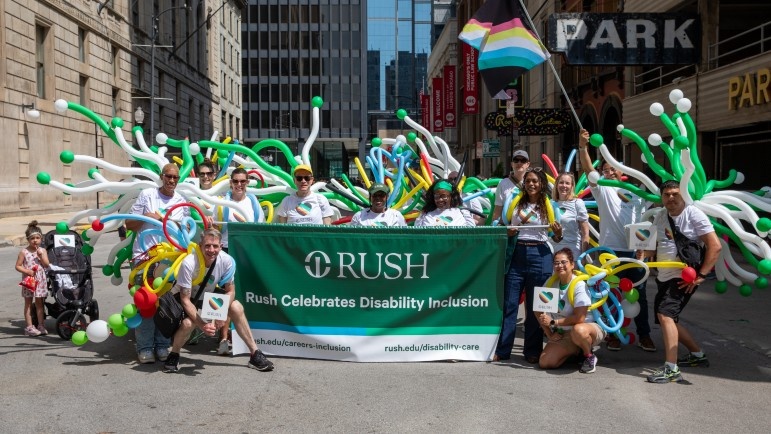
The Office of Student Accessibility Services at Rush University is celebrating 10 years of advocating for students with disabilities, ensuring equal access to educational opportunities and equipping faculty and staff with the tools to develop accommodations that adhere to legal requirements and best practices in higher education.
"We are so excited to celebrate the Office of Student Accessibility. Over the last decade, the office has ensured that students have the resources and support they need to succeed, both in the classroom and as future healthcare professionals," says Debbie Martin, PhD, vice provost of Student Affairs at Rush University. "By continuing to support students of all abilities, we strengthen our community and help prepare compassionate, skilled clinicians who will provide the best possible care for our patients."
Becoming a leader in accessibility services
Rush was an early leader in accessibility services and strives to go above and beyond in ensuring everyone has equal access to education and healthcare. When the Americans with Disabilities Act was passed in 1990, Larry Goodman, former CEO of Rush University Medical Center, and Eugene Thonar, professor emeritus of biochemistry and orthopedic surgery, helped establish the ADA Task Force.
"The ADA Task Force was in response to this new law," says Marie Lusk, MBA, MSW, director of OSAS. "We needed someone to figure out how to implement it in our system. Within a year or so of the ADA passing, the task force was up and running."
Thonar was heavily involved in this work. At age 14, he was diagnosed with ankylosing spondylitis, a chronic condition that severely limited his mobility. Under his influence, Rush implemented accessibility measures, including universal design standards; sign language and interpreter programs; and accessible restrooms, elevators and parking.
As Rush continued to look for ways to increase accessibility, the university opened the Office of Student Disability Services in 2016 within the Division of Student Affairs. The office initially served 34 students with one staff member, Lusk, serving as manager and promoted to director in 2019.
"I had to consider what the institution and faculty needed to know about accessibility and how to implement that education and training as I knew what our students required was equal access," Lusk says. "But it's not a one-size-fits-all. The first six months involved a lot of learning, listening and observing."
In 2017, the university's colleges collaborated on aligning technical standards, which are the non-academic physical, cognitive, sensory and behavioral abilities required for admission, progression and graduation from a program. Rush shifted to inclusive language that educates students on what the technical standards are and how to achieve them with or without accommodation.
Removing the stigma of asking for help
When it came to requesting accommodations, Lusk wanted students to feel comfortable visiting her office. But she recognized the stigma surrounding disability services.
"Students wouldn't even come down to the fourth-floor office suite where I was because there were student aid workers at the main desk," she says. "I only do one thing at Rush, so they knew if they checked in and saw me, their reason for visiting could become known to others. I was there for about three years, and it was low traffic. It was hard, but that highlighted to me that the stigma was real."
The office moved to the ninth floor and was renamed the Office of Student Accessibility in 2019. Not only has Lusk seen a change in demand for their services with more than 400 students seeking accessibility support, but she has seen a change in behavior.
"Now students will walk up to me. They hug and high five me and invite me to events they're hosting," she says. "But that's what I always hoped for — that students weren't ever embarrassed to be seeking support. Because they should never be ashamed of asking for help."
Supporting students, shaping clinicians
OSAS works with students with physical, chronic health conditions, sensory, learning, psychological, temporary and/or injuries. Lusk and her office help document diagnoses and request reasonable accommodations to remove access-related barriers students may experience throughout their educational experience with Rush University, that include in person, remote and in clinical settings.
"To highlight the collaboration that is required when considering an accommodation and addressing barriers, I am proud of the work we did while addressing a physical barrier a student was facing," Lusk says. "We had a student who utilized a wheelchair and could not access a space on campus independently. The solution was to install an ADA Swipe and door opener so that the student could access the space independently. OSAS had to coordinate with administrators from the system and staff who use the space daily to ensure the work did not disrupt their day-to-day operations."
According to Lusk, most disabilities at Rush are not apparent, meaning they are not known or visible to others. The majority are chronic health and psychological learning disabilities. OSAS assists those students with the appropriate accommodations, which could include extra time on examinations, use of assistive technology such as screen readers during assessments and leave for required medical appointments.
While the goal is to provide students with the support required, accommodations do not guarantee success but grant equal access to the educational experience. The experience students registered with OSAS also prepares them to be the next generation of compassionate, educated and skilled clinicians.
"We are training future clinicians and health advocates. If they cannot advocate for themselves, how will they advocate for their patients?" Lusk says. “OSAS speaks at every new student orientation to make sure all new students are made aware of OSAS and the support available. This past year, I presented at the GME orientation to share about Rush’s commitment to accessibility, how to get resources as a Rush employee and that, as a resident here, you might even be working with students who present you with an accommodation letter. And how they are to respond.”
Remaining a leader in accessibility services
Lusk and her team learn and adapt as accessibility evolves in academic and clinical spaces. She is grateful for how much she and her team have learned over the last 10 years and will continue to grow from every experience.
"We have the fundamentals down. Now let's take it to the next level and continue to make Rush a leader in not only research and providing outstanding care for patients but leading in accessibility," Lusk says. "No one should be fighting to get through the door. No one should be stuck in the parking lot. To me, it's 'who gets the access to be healthy?'"