
Community service is the core of Rush University's Clinical Nutrition program. Throughout the five-semester curriculum, students dedicate an entire summer to working alongside organizations across Chicago including Beyond Hunger, the People's Resource Center and One Family Illinois.
"Much of the program is hands-on," says Mark McInerney, DHSc, RD, assistant professor, Department of Clinical Nutrition. "While clinical experience is essential, it's extremely important for students and the profession of nutrition as a whole to be exposed to experiences outside of the hospital."
Students are educated on providing nutrition interventions based on a diagnosis. For example, they learn how to talk to patients with diabetes about carbohydrate counting and help those with high blood pressure understand which foods can support their health. It's during the community semester that students learn what people eat and why they eat the way they do, whether it's preference, culture, access or equipment they have in their houses to prepare meals.
"It [the community semester] prepares students to be better clinicians," McInerney says. "As program director, one of my priorities is making sure students are out in the community because these are the individuals they may see in the hospital. These are the individuals they are working for — the individuals they want to be healthy."
Exposure: a key ingredient in personalized care
Lillian Sawyer is a second-year student in the Clinical Nutrition program. She spent her community semester building a cooking class program for One Family Illinois — a foster care system that keeps siblings together, empowers youth and nurtures strong families. Sawyer and her classmates taught teenagers foundational cooking skills and nutritional knowledge.
Sawyer has also been involved in Rush's Food is Medicine program and the Greater Chicago Food Depository. Community service and diverse populations are why she chose Rush.
"I'm from Indiana where the demographics are very different from those in Chicago," Sawyer says. "Rush and its community have exposed me to people from all walks of life, each with different needs. I've learned the importance of asking questions and understanding everyone's background so I can personalize my care."
McInerney says exposure like what Sawyer experienced is what creates empathy.
"Relying on federal programs to put food on the table or not knowing where your next meal is coming from is a real stressor for many families. A lot of times, nutrition isn't the priority. The unhealthier option is usually the most convenient, fast and affordable," he says. "I think that's a real eye-opener for many of our students. It gets them thinking 'not everyone grew up like I did' and has them approach every situation a little bit differently."
A hands-on approach to community health
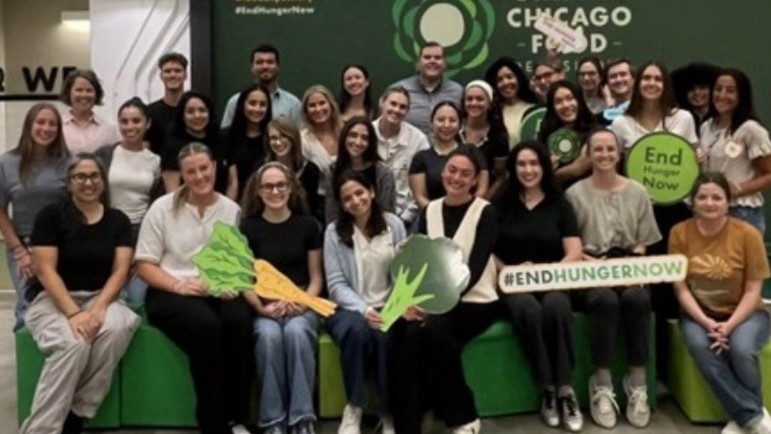
As part of orientation for the fall 2026 semester, students and faculty volunteered at the Greater Chicago Food Depository. They packed 16,830 pounds of food, which provides more than 14,000 meals to people in the community.
"We talk a lot about nutrition, so it's nice to step back and look at the bigger picture," McInerney says. "Combining orientation with a volunteer opportunity allowed students to get to know each other better while doing something good for the community."