
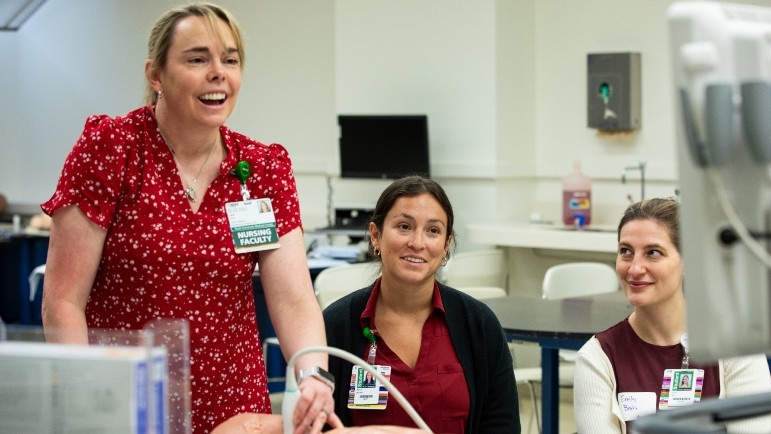
The world of healthcare continues to advance at a rapid pace. Patients are living longer with more complex conditions, technology is reshaping how clinicians make decisions and deliver care and nurses are increasingly being called upon not simply to respond to change, but to lead it.
As healthcare continues to change, the approach to nursing education is evolving with it. At Rush University College of Nursing, this rapid change is an opportunity to reimagine how it prepares its students to enter the profession at different points in their careers.
The College of Nursing is currently revising its curriculum, finding answers to questions around what its graduates need to know to care for patients, improve health and be leaders in health care who are driving change.
Connecting education to practice
The transformation reflects a broader movement in nursing education toward competency-based learning. The American Association of Colleges of Nursing introduced a new competency-based framework for nursing education at the entry and advanced levels of practice, known as The Essentials.
The change places greater emphasis not simply on the knowledge students acquire, but on their ability to apply that knowledge and demonstrate the skills and judgment required in practice.
“A competency-based education gives faculty better control and greater confidence in their students’ ability to enter and advance in nursing,” says Frank Hicks, PhD, RN, CEN, ANEF, associate dean for academic programs and affairs. “It’s ensuring our practice partners know exactly what to expect of a Rush University nursing graduate.”
That connection between education and practice is central to the Rush approach. Faculty have engaged students and clinical practice partners to create an academically rigorous educational experience that reflects the realities of contemporary nursing practice across hospitals, ambulatory and community settings, homes, public health organizations and healthcare systems.
Mapping out the future
Revising the curriculum has been a collaborative process, one that exemplifies the nature of academic nursing. Rush nursing faculty mapped more than 90 courses against the AACN Essentials and examined where the curriculum is strong, where greater integration is possible and where emerging needs demand something new.
“Although the curriculum mapping process was a significant undertaking, it was completed successfully through the dedication of faculty across the College of Nursing,” says Yasmin Cavenagh, DNP, MPH, associate professor, Department of Women, Children and Family Nursing. “The work yielded valuable insights into the curriculum’s existing strengths and identified areas for enhancement. We are all looking forward to revising the curriculum based on our findings.”
The mapping process included faculty from across the MSN and DNP programs who participated in workgroups to help competency-based education into course and curricular design.
“It's really allowed us to have as many faculty involved as we can throughout the process and be as intentional as possible since we’re providing support, resources and structures that will support all of us in doing this really important work because it takes everyone,” says Mallory Bejster, DNP, RN, MSN, Clinical Nurse Leader program track director.
Evolving with students' needs
The College of Nursing developed new student learning outcomes to guide the revision of the curriculum. These learning outcomes provide faculty with a framework for designing the curriculum, assessing student achievement, supporting continuous improvement and communicating what students are expected to know and be able to do upon graduation.
Rather than treating the curriculum as a collection of individual courses, Rush is designing a more intentional learning journey. Students will be able to build a better understanding through classroom and active learning while also being able to apply and demonstrate that understanding in clinical practice.
For students preparing to become registered nurses, clinical learning will be deliberately integrated with coursework so they can synthesize knowledge and apply it across different care environments.
For nurses pursuing graduate education, the curriculum will support increasingly sophisticated preparation for advanced clinical practice, leadership, evidence translation and systems improvement.
“The curriculum revision process gives us the opportunity to grow with our students, grow with health care and learn along the way,” says Lynette Richter, DNP, RN, assistant dean for the MSN program. “We talked to students and interviewed them to see what they think their needs are, resulting in a more collaborative and student-focused curricular process.”
Embracing technology and preparing future leaders
Tomorrow’s registered nurses and advanced nursing professionals will practice in a world increasingly shaped by data and advancing technology, including AI. Rush nursing students will learn not simply how to use these tools, but also how to evaluate and apply them responsibly.
Courses such as Informatics, Technology-Driven Decision-Making will strengthen understanding of the safe and ethical use of technology. Students will learn to use AI as a tool without allowing it to replace critical thinking, judgment or decision-making. These courses reaffirm the importance of the human-aspect of the nursing profession that is grounded in compassionate, patient-centered care.
Utilizing technology is one of the many ways the College of Nursing is working to prepare its students to be leaders in health care.
Graduate nursing education must also reflect the expanding ways nurses influence health care. Advanced practice registered nurses provide highly skilled clinical care. Other graduate-prepared nurses lead organizations and teams, improve systems, translate evidence into practice and advance the quality and safety of care.
“Rush is thought of as a leader in nursing education, and I believe our next curriculum version will continue to build on this legacy,” says Sarah Livesay, DNP, APRN, FNCS, FAAN associate dean, Practice Scholarship and Specialty Education. “We’ve approached the updated Essentials with open arms, deciding what we want to keep from our existing curriculum and where we want to adapt and take this opportunity to change and lead.”
A look into what comes next
The revised curriculum is scheduled to launch in fall 2028. It will give faculty a clearer, more comprehensive view of how students develop and apply their knowledge, skills and judgment throughout their educational journey. In turn, Rush graduates will be prepared not only to meet the needs of today’s health care system, but also to lead its continued transformation.