
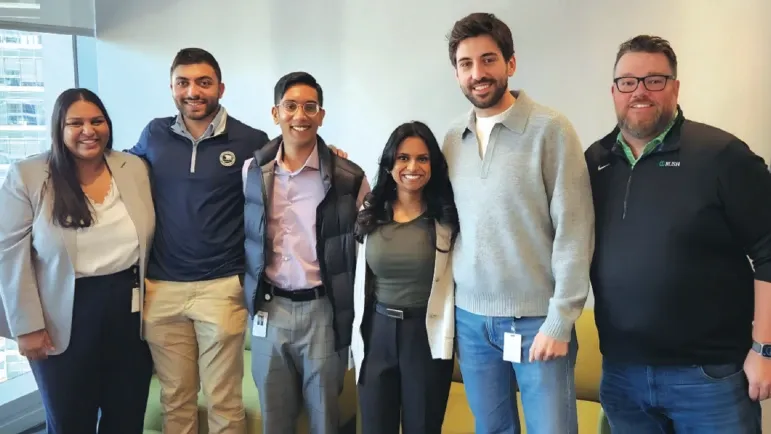
The supportive culture within the Master of Science in Health Systems Management (HSM) program was ultimately what drew Kevin McCarthy, MS-HSM, a 2013 graduate, to return as adjunct faculty to share his knowledge from the consulting world.
“At Rush, there is an ethos within the HSM program that’s always resonated with me, and that is to pay it forward,” McCarthy says. Since 2017, he has been teaching one of the program’s most popular elective courses on consulting during the spring semester.
Thinking like a consultant
McCarthy finished the HSM program while working in information systems at Rush. “One of the things I really loved about the HSM program was the teacher-practitioners, who brought tangible, real-world knowledge. They were working every day but still made time for me,” he says.
In 2013, he left Rush to join Navigant — which changed its name to Guidehouse in 2019 — as managing consultant. Today, he is a director at the firm. Every fall, McCarthy invites Rush students to visit Guidehouse.
“It’s a chance for them to meet some of the key stakeholders in our organization and see what consulting looks like day to day, so it’s not just theoretical,” he says. “The students also make connections and meet people other than me who can help mentor them in their career."
“At Rush, there is an ethos within the HSM program that’s always resonated with me, and that is to pay it forward.”
– Kevin McCarthy, MS-HSM, consultant and adjunct faculty in the Department of Health Systems Management
For students in both the full-time and part-time/residential HSM tracks, the visit is a highlight of the program. “While the students can get overwhelmed with lunch-and-learns and networking events, the visit to Guidehouse is by far the best on their schedule,” says Diane Howard, PhD, MPH, chairperson of the Department of Health Systems Management. “It’s because Kevin works to present a compelling and engaging course where students can see themselves as consultants.”
The Consulting course, like the rest of the HSM curriculum, is designed to help students succeed in a variety of leadership roles in health care. “Consulting is experiential, so while this class isn’t going to make you a great consultant on its own, it does provide a framework that will serve you well if you go into consulting,” McCarthy says. “But even if you take another role in the health care industry, you can apply the same framework.”
Small classes, big benefits
Small class sizes within the HSM program — which is ranked among the top 5 programs in the country, according to U.S. News & World Report — allow students to benefit from more personalized mentoring from faculty like McCarthy. For example, he helps prepare students for interviews with consulting firms, such as helping them navigate the differences between a behavioral interview and a case study interview.
Cultivating connections is important in most health care careers, but it is especially critical in consulting. “That’s how I’ve advanced in my career,” McCarthy says. “I always tell my students that I’m happy to help them use my network.”