
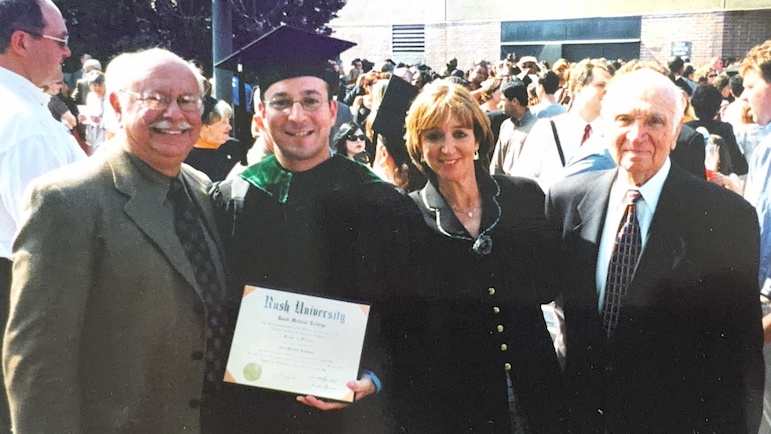
When Eric Feldman, MD ’01, applied to medical school, he sought an environment where the learning opportunities felt personal, the faculty were accessible and his classmates were of high character.
“I was very fortunate to be able to attend Rush Medical College,” Feldman said. “It was everything I could have wanted in a medical school training program.”
But, like many medical students, Feldman worried about how he would pay for his education. Thankfully, his grandparents, Rose and Julius Meskin, were strong advocates of education and financially supported his medical school journey.
“My grandparents felt tremendous pride that I was training to become a physician,” Feldman said. “They told me if I wanted to go to Rush, they would do their best to help. It takes a weight off your shoulders knowing you won’t have such large loans to repay.”
Their support helped Feldman earn a medical degree, paving the way to a successful career. To show his gratitude, he and his wife, Dayna, recently made a commitment to establish the Rose and Julius Meskin Endowed Scholarship, with a pledge to continue supporting it over time.
“I always knew that if I could one day pay it forward, that would be the best way to honor my grandparents,” Feldman said. “This was the right time for us to do it."
Reflecting and looking ahead
Feldman is now board-certified in physical medicine and rehabilitation, and fellowship-trained in pain management and interventional spine care. He practices with The CORE Institute in Arizona and teaches medical students and residents.
“Where I am today has a lot to do with the exceptional training I received at Rush,” he said.
With his 25-year Rush Medical College reunion around the corner, Feldman has found himself looking back fondly on his time at Rush.
“My four years at Rush were challenging, but they were also very enjoyable — something my three children have a hard time believing,” he said.
Feldman is also looking toward the future for healthcare. His son recently completed EMT training and is pre-med at the University of Michigan. And Feldman knows that the challenges of paying for medical education have only grown.
The United States is expected to face a shortage of 86,000 physicians by 2036, according to the Association of American Medical Colleges. Approximately 80% of Rush Medical College students received some form of financial aid during the 2023-2024 academic year, including loans.
Feldman hopes his family’s scholarship can help take some pressure off students as they prepare to become future healthcare professionals. He also hopes this encourages others to support the Rush education that played such an important role in his life.
“I want Rush to be able to keep doing what they’ve been doing — bringing in the well-rounded, compassionate students who are going to be excellent physicians,” Feldman said. “If we can help with some of the financial burden, we have done a good thing.”