
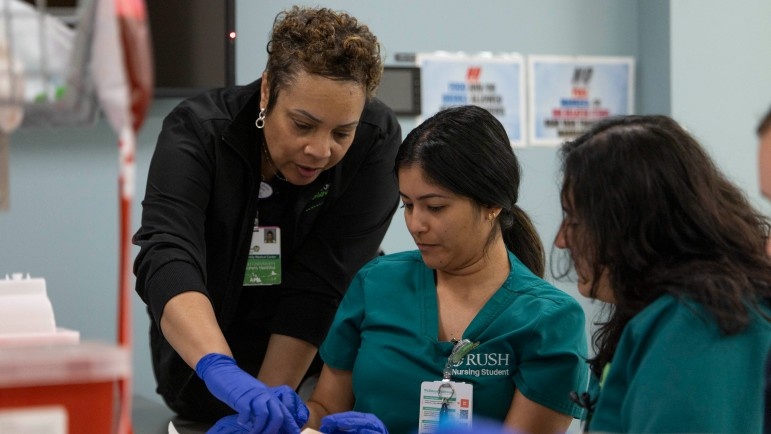
The College of Nursing at Rush University celebrated 100% of Doctor of Nursing Practice (DNP) students placed for spring 2026 and strong placements for the summer 2026 term. Securing 100% placement came much earlier than previous years thanks to its new Advanced Practice Provider Pilot Program.
Rush’s DNP students are required to complete a significant number of hours of direct care clinical precepting, which involves real-world clinical experience between students and health care professionals. This teacher-practitioner model provides students with hands-on experience that enhances their training as they prepare for the next step in their career after graduation.
However, it has been a struggle for institutions nationwide to find providers who are able to commit their time to so do.
Molly Erickson, DNP, APRN, senior director, Office of Advanced Practice, says there are a few reasons for this.
First, APPs have been recognized as a key solution for access to care and are now in high demand. APPs often manage a heavy workload that may prevent them from dedicating time to teaching. Another factor can include having multiple trainees from multiple professions that may limit an APP’s ability to serve as a preceptor.
Sarah Livesay, DNP, APRN, associate dean, Practice Scholarship, College of Nursing, says the dynamics of placing APRN students in clinical preceptorship has changed significantly over the past decade. Erickson also noted that the COVID-19 pandemic exacerbated challenges as long-standing relationships between educators and clinicians have changed in light of remote work and shifting priorities.
To address this gap, Erickson and Livesay collaborated to introduce the Rush APP Preceptor Pilot Program. The program recognizes the time and effort required to precept students and provides administrative relief time built into the preceptor’s work week if they commit to precepting students for several years.
For example, participating in the program might mean one less 12 hour shift every six weeks or one less hour of clinic each week. For the College of Nursing, the partnership solidifies a relationship between the preceptors and nursing faculty and ultimately improves the quality of clinical preceptorship for DNP APRN students.
“We are thrilled to see the number of Rush APRN preceptors increase as a result of the program,” says Livesay. “This allows us to partner Rush APRN students with some of Rush’s best APP providers so the focus is on training the next generation of nurse leaders, rather than searching for preceptors outside our own system.”
Introducing the pilot for the spring 2026 term, the College of Nursing worked with APPs throughout the Rush system to quickly ensure clinical placements for DNP students. The initial reaction to the pilot was so successful, the College of Health Sciences joined in spring of 2026 and physicians assistant students are now benefitting from the placements.
The College of Nursing is optimistic that this new placement pilot will lead to positive outcomes in the future. The new program has the opportunity to open doors for more APPs to interact with and provide impactful guidance and mentorship to students as they continue their education at Rush.