
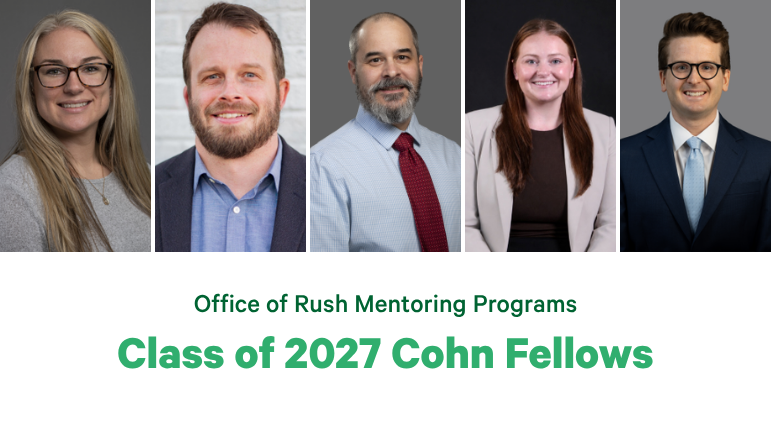
Rush University recently selected five faculty members as Cohn Fellows who will receive grant support for their research across a variety of disciplines.
Each year, the Cohn Family Foundation provides grant funding to support junior faculty at Rush University who are participating as mentees in the Rush Research Mentoring Program.
Selected mentees receive support to gather preliminary data for research proposals and to advance their ongoing research activities. This support is imperative because faculty — particularly early-career faculty — may struggle to find the time for research and other scholarly activities.
“Faculty are the stewards of the university’s mission. They are the driving force behind discovery, education, innovation, and clinical excellence to improve the health and well-being of the communities we serve.” says Julie Hoff, PhD, MPH, RN, FAAN, provost, Rush University. “Their time and efforts are invaluable, and it’s important to us that they are given the support and time needed to achieve their goals while educating, mentoring, and professionally forming the next generation of healthcare professionals.”
Through pilot grant funding and protected time for research, the Cohn Fellowship has significantly enhanced the academic progress of recipients. Recipients have gone on to secure extramural funding; produce peer-reviewed publications; present at regional, national and international conferences; and achieve academic promotion.
“Securing funding at such an early stage in their careers not only advances the incredible work these researchers do, but goes on to benefit our community,” says Hoff. “Rush is committed to advancing translational research and implementation science by finding innovative solutions and putting them into practice at the bedside and throughout our communities.”
Five RRMP mentees are chosen annually through a competitive review process, with funding distributed equally among the awardees.
Please join us in congratulating this year’s fellows.
Brittany M. Wilson, PhD
Brittany Wilson, PhD, is an assistant professor in the Department of Anatomy and Cell Biology at Rush Medical College. Her research focuses on musculoskeletal outcomes associated with disruptions in fetal development and preterm birth. Utilizing a combination of translational animal models and human tissues, along with advanced skeletal imaging modalities and measurement techniques, Wilson aims to deeply characterize bone development and mineral metabolism after preterm birth and other early life development disruptions.
As a Cohn Fellow, Wilson intends to improve the understanding and management of bone mineral balance during early postnatal life after preterm birth and determine if stable calcium isotopes are useful in diagnosing and monitoring metabolic bone disease of prematurity in infants.
John Martin, PhD
John Martin, PhD, is an assistant professor in the Department of Orthopedic Surgery at Rush Medical College. For more than a decade, Martin has studied degeneration, regeneration and physical function of the musculoskeletal system, primarily the spine. His early work in regenerative medicine included developing injectable therapies and engineered tissues to improve or replace the intervertebral disc of the lumbar spine, a tissue that naturally degenerates with age and is implicated in low back pain. To monitor regeneration, his work progressed to developing in vivo imaging tools to quantify soft tissue structure, composition, function and physiology. Martin has developed expertise in human MRI, CT and PET imaging analyses and built data science tools to link imaging information with patient factors.
Martin’s research group takes a holistic approach to low back pain by integrating the drivers of spine disease with the circumstances of the patient, from degenerative disc disease to the social determinants of health.
Kevin Buell, MBBS, MS
Kevin Buell, MBBS, MS, is an assistant professor in the Department of Internal Medicine, Division of Pulmonary, Critical Care and Sleep Medicine at Rush Medical College. His research aims to individualize and improve care for critically ill patients. As a steering member of the Common Longitudinal ICU data Format consortium, he uses a federated approach across 10 U.S. health centers to apply novel biostatistical, data science and machine learning techniques to large, nationally representative observational data from the electronic health record and to study associations between care variations and patient outcomes. By conducting prospective, randomized, pragmatic clinical trials, he also identifies the definitive causal effect of care variations on patient outcomes. His research areas include antimicrobial stewardship, bag-mask ventilation, tracheal intubation and mechanical ventilation.
As a Cohn Fellow, Buell will look to quantify the variability and determinants that drive broad-spectrum antibiotic use and prevent antibiotic de-escalation. By defining patient, clinician, and geographic contributions to broad-spectrum antibiotic use and de-escalation, this research will help shift antimicrobial stewardship from a one-size-fits-all approach toward data-driven interventions grounded in objective measures of antibiotic broadness. This work will identify key predictors of broad-spectrum antibiotic use and de-escalation, which will subsequently be used to develop and validate real-time clinical decision support tools that incorporate data on dynamic patient trajectories, clinician prescribing patterns and ICU culture.
Phillip Malloy PT, PhD
Phillp Malloy, PT, PhD, is an assistant professor in the Department of Physical Medicine and Rehabilitation and Department of Orthopedic Surgery at Rush Medical College. He serves as the director of the Movement and Applied Rehabilitation Science Laboratory. His research focuses on understanding the biomechanical factors that may contribute to symptom development or can become altered in people with femoroacetabular impingement syndrome. His long-term research goal is to use human movement biomechanical data to inform rehabilitation treatment progressions for patients electing both non-operative and operative interventions for FAIS.
Malloy’s Cohn Fellowship will longitudinally assess changes in biomechanics during postoperative rehabilitation in patients with FAIS following hip arthroscopic surgery. This research will build on his prior longitudinal work that measured patients between six and 12 months after surgery by assessing patients at early — less than or equal to three months — postoperative time points, which is when patients are still receiving postoperative rehabilitation. This work will also implement a battery of standardized clinical movement tests to promote clinical translation to rehabilitation treatment progressions after hip surgery for FAIS. The Cohn Fellowship will provide the necessary foundational data for a future rehabilitation intervention clinical trial in people with FAIS.
Samantha Addante, PhD
Samantha Addante, PhD, is an assistant professor and licensed clinical psychologist in the Department of Psychiatry and Behavioral Sciences at Rush Medical College. Her research focuses on developing and implementing service delivery models to improve identification and treatment of perinatal posttraumatic stress disorder, with an emphasis on translating evidence-based trauma interventions into real-world obstetric and community settings.
Her Cohn Fellowship project centers on developing and testing an integrated care model designed to embed PPTSD screening, referral pathways and evidence-based trauma treatment into OB clinics. Through stakeholder engagement and implementation science methods, this work aims to identify barriers to care and pilot strategies that improve uptake of trauma-focused services during pregnancy and postpartum. This research will generate critical preliminary data to support scalable, sustainable approaches to perinatal mental health care, with the long-term goal of improving maternal mental health and reducing intergenerational impacts of trauma.