
Introduction
Diagnostic medical sonographers play a crucial role in the diagnosis and treatment of patients with a broad range of medical conditions. Diagnostic medical sonographers are health care professionals who use specialized imaging equipment to obtain data and create images of various internal body structures, including, but not limited to, blood vessels, organs and soft tissues.
Our Bachelor of Science (BS) in Diagnostic Medical Sonography Program provides you with skills in the following:
- Communication
- Physical and intellectual scanning with ultrasound
- Analysis of images and data
- Reporting findings of the ultrasound exam to the interpreting physician
This two-year Diagnostic Medical Sonography program enables you to earn a bachelor’s degree and become eligible to take the American Registry of Diagnostic Medical Sonographers (ARDMS) certification examinations to earn both the Registered Vascular Technologist (RVT) and Registered Diagnostic Medical Sonography, Abdomen specialty (RDMS(AB)) credentials.


Rush's approach: BS in Diagnostic Medical Sonography
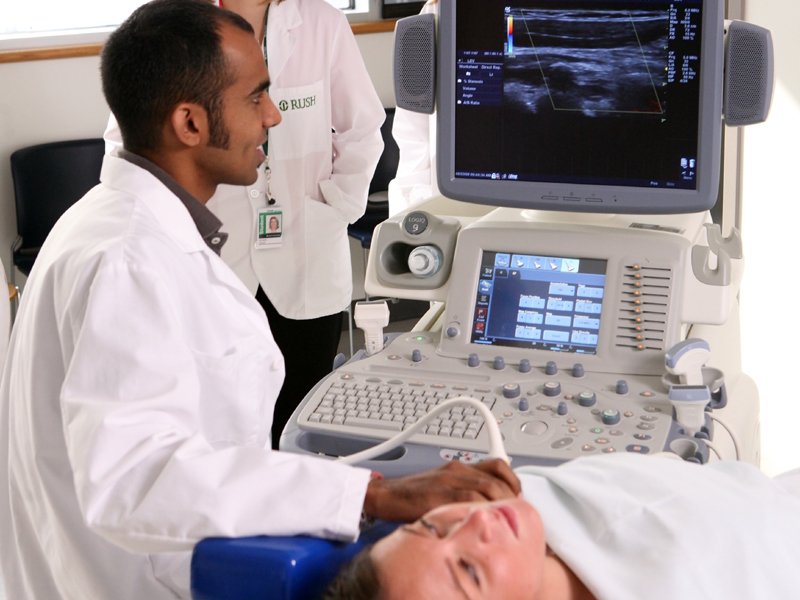
We use a teacher-practitioner model. That means your teachers in the classroom, lab and clinic are experienced practitioners in their fields.
Your first year of study consists of classroom learning, student laboratory work and observing patient examinations at Rush. In your second year, you will perform examinations on a diverse population of patients.
Examinations are performed under the direction of credentialed diagnostic medical sonographers at two or more diagnostic ultrasound laboratories.
Mission
The mission of the Vascular Ultrasound and Technology program is to improve the quality and availability of diagnostic vascular ultrasound examinations for patients by educating students in the knowledge, skills and behavior necessary to competently perform vascular ultrasound examinations.
Goals
The primary goal of the program is to prepare competent entry-level vascular technologists in the cognitive (knowledge), psychomotor (skills) and affective (behavior) competencies necessary to perform vascular ultrasound examinations.
A secondary goal is to offer a broader understanding of the profession to the students through basic education in professional practices.
Diagnostic Medical Sonography Bachelor’s Degree program length and location
The BS in Diagnostic Medical Sonography program is a full-time, on-campus program that is completed in 24 months.
First year
You’ll start the program in September and participate in two semesters of classroom and student laboratory experiences. You’ll learn to perform ultrasound exams in the student lab the first week of classes and continue to improve your skills throughout the program. You’ll rotate through the hospital lab to observe patient exams being done by professionals at Rush before scanning patients during the second year.
All technical courses are taught by experienced, credentialed registered diagnostic medical sonographers.
Second year
You’ll improve your skills by performing vascular exams on patients under the supervision of an RVT in rotations through two or more clinical sites (diagnostic ultrasound laboratories). You'll attend one course each semester, either at Rush or through the internet, primarily to write and present patient case studies.
One course is dedicated to preparation for the national credentialing examination offered by the American Registry for Diagnostic Medical Sonographers (ARDMS). This is for the RVT and RDMS(AB) credentials after graduation.
Clinical rotations
Clinical sites are located both within the Chicago area and beyond. You are typically assigned to Chicago-area labs for two rotations and one lab outside Chicago for two rotations.
The Chicago-area clinical sites include university and community hospitals and private labs. Clinical site locations outside Chicago currently include vascular labs in the following areas:
- Springfield, Illinois
- Ann Arbor, Michigan
- Boston, Massachusetts
- New Hampshire
- Raleigh/Durham, North Carolina
- Charleston, South Carolina
- Tampa, Sarasota and Miami, Florida
- Seattle, Washington
Lab locations may change slightly each year. Upon admission, all students must agree to attend a clinical site outside the Chicago metropolitan area for two of the four rotations in the year.
Assignments outside of Chicago are assigned during the spring semester of the first year using a preference/lottery system. Students first rank the locations by preferences, and a lottery system establishes the assignment of each according to the preference rank.
Final clinical assignments for the Chicago area are made by the program director working with the clinical coordinator. All site assignments may change at the discretion of the program as necessary.
Housing, living and travel arrangements to the clinical sites are the responsibility of the student. We have graduates and clinical instructors who are happy to assist with suggested areas for housing.
Each year, there may or may not be a chance for one to two students to be assigned to Chicago-area only sites.
This opportunity will be determined just before interviews begin in late December or early January.
It primarily depends on the number of clinical sites available that year. The opportunity is only offered to the first one to two students accepted in the rolling admission process if it is offered.
Graduation
Students who successfully complete the program are eligible to take the ARDMS credentialing exam to earn the RVT and RDMS(AB) credentials.
Pass rates for our students have been excellent (92-100% for the past five years).
According to the ARDMS, students from programs accredited by the Commission on Accreditation of Allied Health Education Programs who pass the ARDMS exams before graduation receive the RVT credential upon graduation.
Diagnostic Medical Sonography program tuition
We know your education is a big investment. We want to make sure you have all the information you need to make the best financial decisions for you and your family.
Tuition for the Bachelor of Science (BS) in Diagnostic Medical Sonography program is $906 per credit.
Inside the diagnostic medical sonography community at Rush
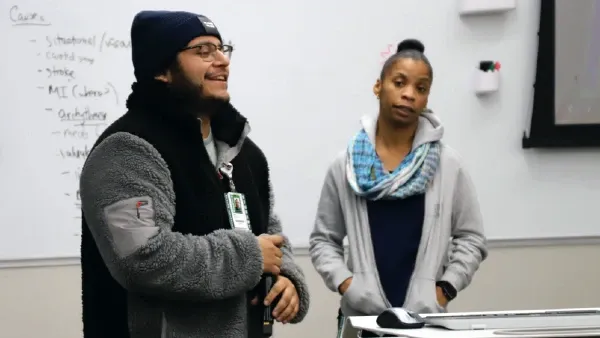
“I can apply what I learned because I’m the front line for these new students. We have to be able to hold ourselves up before we can hold someone else up.”
– Nada, vascular ultrasound BS '23 and clinical preceptor
"I’m proud of our teacher-practitioner faculty model, and the extensive clinical rotations our students complete. Our graduates have the skills and independence to hit the ground running in a variety of practice settings.”
– Jackie Ortiz, MA, RVT
Assistant professor and program director
Diagnostic Medical Sonography career opportunities
Our graduates have a 92-100% job placement rate (vascular positions within six months past graduation) over the past three years.
Job openings submitted by employers to our program are forwarded to all graduates.
Half or more of these jobs were located in the Chicago area.
Employment of diagnostic medical sonographers is expected to increase 13%, according to the U.S. Bureau of Labor Statistics. This is above average compared to other occupations. The U.S. Bureau of Labor Statistics reports a median salary of $89,340.
Diagnostic Medical Sonography program outcomes and effectiveness
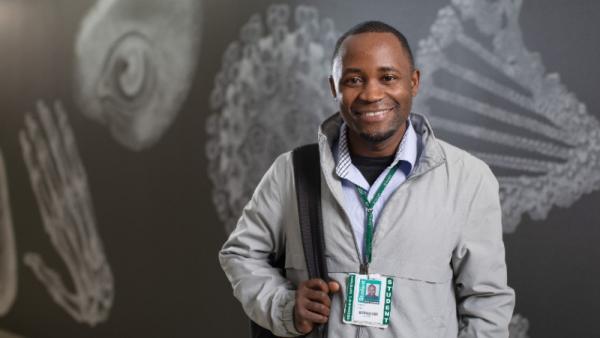
Rashidi Kitete will never forget the startling sounds of war the day he was forced to leave his home. Now he’s using the power of sound to help diagnose patients and save lives.
 College of Health Sciences
 College of Health Sciences
 College of Health Sciences
 College of Health Sciences
 College of Health Sciences
(312) 942-7120
chs_admissions@rush.edu
Learn about upcoming sessions and events in your field of interest.
Sign up to receive more information about this program.